
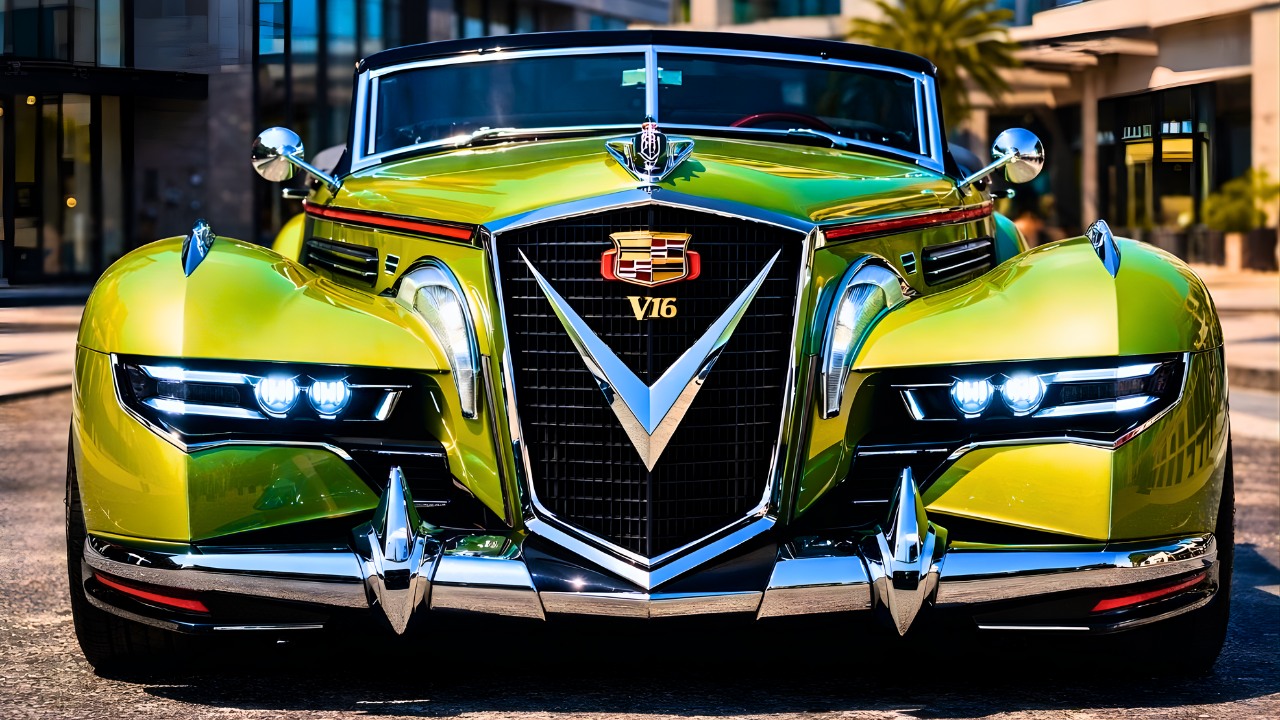
Cadillac V16: Cadillac has always been a brand that symbolizes American ambition. From groundbreaking engines to bold luxury statements, it has never been afraid to think big. Now, with growing talk around a possible 2026 Cadillac V16, that spirit of ambition feels alive again. Whether viewed as a bold vision or a serious direction, the idea of Cadillac bringing back a V16 engine represents a dramatic shift in an automotive world dominated by downsizing and electrification.
This isn’t about chasing trends. It’s about reclaiming a legacy and reminding the world what American luxury engineering once stood for.
A Look Back at Cadillac’s Legendary V16 Era
Cadillac’s relationship with the V16 engine dates back nearly a century. In the early 1930s, the brand stunned the world by producing one of the most sophisticated engines of its time. While competitors focused on straight-eight engines, Cadillac introduced a V16 that delivered unmatched smoothness and refinement. It wasn’t built for racing or raw speed; it was built for prestige, balance, and effortless power.
That reputation cemented Cadillac as a leader in luxury innovation. Owning a V16 Cadillac was less about performance numbers and more about status and craftsmanship. The engine itself became a symbol of mechanical elegance, something few manufacturers could even attempt.
Decades later, Cadillac reignited that dream with the Sixteen concept car, which showcased what a modern interpretation of a V16 could look like. Although it never reached production, it left a lasting impression and proved that Cadillac still knew how to inspire imagination.
Why a V16 Return Feels So Radical Today
In today’s automotive climate, the idea of a V16 feels almost rebellious. Manufacturers are racing toward electrification, efficiency, and smaller engines boosted by turbochargers. Even high-end luxury cars now rely heavily on hybrid systems and software-driven experiences.
Against that backdrop, a V16-powered Cadillac would stand apart instantly. It wouldn’t exist to dominate sales charts or appeal to the masses. Instead, it would serve as a statement car, designed to remind the world that luxury can still be emotional, mechanical, and deeply personal.
A modern V16 wouldn’t need to be excessive in a reckless way. With today’s engineering tools, such an engine could be smoother, cleaner, and more refined than ever before. It would represent control rather than chaos, power delivered with elegance instead of aggression.
Imagining the 2026 Cadillac V16 Powertrain
If Cadillac were to bring back the V16 in 2026, it would almost certainly be a thoroughly modern creation. Lightweight materials, advanced cooling systems, and precision engineering would shape its design. The focus wouldn’t just be on peak output but on how power is delivered across the rev range.
A V16 naturally excels in smoothness. With so many cylinders working in harmony, vibrations are minimal and torque delivery feels effortless. Acceleration wouldn’t feel sudden or violent. Instead, it would build with confidence, creating a sense of endless momentum rather than explosive bursts.
There’s also the possibility of electrified assistance. A mild hybrid system could enhance low-speed response and improve efficiency while preserving the character of the engine. This would allow Cadillac to respect modern regulations without compromising the emotional appeal of a large displacement powerplant.
Design That Reflects Authority and Elegance
A car powered by a V16 demands a design that communicates presence. This wouldn’t be a subtle vehicle. Long proportions, a commanding hood, and a wide stance would define its silhouette. The design language would likely blend modern Cadillac sharpness with classic cues that echo the brand’s historic flagships.
Every detail would need intention. From the grille to the lighting elements, the car would signal importance without relying on unnecessary aggression. It would look expensive, confident, and unmistakably American in character.
This wouldn’t be a car meant to blend into traffic. It would feel like a moving landmark, something that draws attention quietly rather than demanding it loudly.
Interior as a Showcase of Craftsmanship
Inside, a 2026 Cadillac V16 would represent the pinnacle of the brand’s interior philosophy. Screens and technology would certainly be present, but they wouldn’t dominate the experience. Instead, the cabin would focus on materials, comfort, and sensory richness.
Hand-stitched leather, real wood trim, and metal accents would remind occupants that they’re in something special. Controls would feel substantial and satisfying, designed to be used rather than just admired. Seating would prioritize long-distance comfort, allowing the car to function as a true grand tourer.
The goal wouldn’t be to overwhelm the driver with features but to create an environment that feels calm, powerful, and refined. Luxury here would be about how the space makes you feel, not how many features it lists.

Why This Would Shock the American Market
American car culture has become increasingly focused on numbers. Horsepower ratings, acceleration times, and screen sizes dominate conversations. Cadillac itself has leaned heavily into performance electric vehicles and tech-driven experiences in recent years.
A V16-powered flagship would flip that narrative. It wouldn’t exist to win drag races or dominate spec sheets. Instead, it would appeal to buyers who value craftsmanship, heritage, and the emotional connection between driver and machine.
For many Americans, especially younger enthusiasts, this could be an eye-opening reminder that luxury doesn’t always mean digital or electric. It can also mean mechanical beauty, sound, and feel.
What This Means for Cadillac’s Identity
Even if a 2026 Cadillac V16 remains a conceptual idea rather than a confirmed model, the discussion itself reveals something important. Cadillac’s brand DNA is rooted in leadership, innovation, and confidence. A V16 represents those values in their purest form.

In an industry moving rapidly toward uniform solutions, standing out requires courage. Revisiting the V16 concept would show that Cadillac is willing to honor its past while still thinking boldly about the future.
It would also send a clear message that American luxury doesn’t have to follow European templates or global trends. It can define its own path, just as Cadillac once did.
Final Thoughts
The idea of a 2026 Cadillac V16 is powerful because it challenges expectations. It reminds us of a time when cars were built not just to meet regulations or market demands, but to inspire awe. Whether or not such a model ever reaches production, the vision itself carries weight.
A V16 Cadillac would be more than a car. It would be a symbol of confidence, heritage, and the belief that luxury should stir emotion as much as it delivers comfort. In a world racing toward the future, it would be a bold reminder that sometimes, looking back can be just as revolutionary.